


|
Oil Cooled Transformer
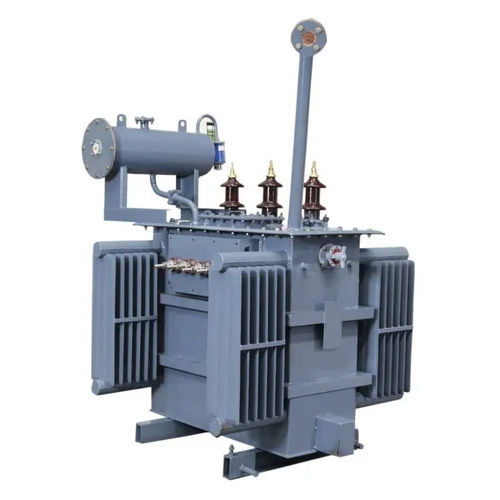

Oil Cooled Transformer Specification
- Voltage Booster Type
- Dry
- Product Type
- Other
- Material
- Stainless Steel
- Frequency (MHz)
- 50 Hertz (HZ)
- Efficiency
- High
- Phase
- Three Phase
- Usage
- Industrial
- Power Scope
- Electricity
Oil Cooled Transformer Trade Information
- Minimum Order Quantity
- 10 Units
- FOB Port
- sonipat
- Payment Terms
- Cash Advance (CA), Cash in Advance (CID)
- Supply Ability
- 25 Units Per Month
- Delivery Time
- 15 Days
- Sample Policy
- Contact us for information regarding our sample policy
- Packaging Details
- raping
- Main Export Market(s)
- Asia
- Main Domestic Market
- All India
About Oil Cooled Transformer
An oil-cooled transformer is a type of electrical transformer that uses dielectric insulating oil as its primary cooling medium and often as part of its insulation system. This design is widely adopted for medium to large power transformers, and even some distribution transformers, due to the superior heat dissipation and insulating properties of oil compared to air.
Why Oil Cooling?
Electrical transformers generate heat due to various losses:
- Copper Losses ( losses): Heat generated in the windings due to the resistance of the conductor material.
- Iron Losses (Core Losses): Heat generated in the magnetic core due to hysteresis and eddy currents.
As transformer size and voltage ratings increase, these losses become more significant, and efficient heat removal becomes critical to prevent overheating, which can degrade insulation, shorten the transformer's lifespan, and lead to failure. Air cooling alone is often insufficient for larger units.
Key Components and How They Work
-
Transformer Oil (Insulating Oil):
- Cooling: The oil circulates around the core and windings. As it comes into contact with the hot components, it absorbs heat. The heated oil then rises, moves into cooling tubes/radiators, cools down, becomes denser, and sinks, creating a natural convection current (thermosiphon principle). This continuous circulation efficiently transfers heat away from the active parts.
- Insulation: The oil possesses high dielectric strength, meaning it's an excellent electrical insulator. It fills the spaces between windings and between windings and the tank, preventing electrical arcing and short circuits. It also helps to impregnate and reinforce solid insulation materials like paper and pressboard.
- Arc Quenching: In the event of an internal fault, the oil helps to quench arcs.
- Cooling: The oil circulates around the core and windings. As it comes into contact with the hot components, it absorbs heat. The heated oil then rises, moves into cooling tubes/radiators, cools down, becomes denser, and sinks, creating a natural convection current (thermosiphon principle). This continuous circulation efficiently transfers heat away from the active parts.
-
Transformer Tank: A robust steel enclosure that houses the core and windings and contains the transformer oil. It's designed to withstand the weight of the oil and internal pressures.
-
Cooling Radiators/Fins: External heat exchange surfaces (often corrugated panels or separate tube banks) connected to the main tank. As the heated oil flows through these radiators, it is exposed to the cooler ambient air, dissipating heat through convection and radiation. Fans can be added for forced cooling (ONAF/OFWF).
-
Oil Conservator (Expansion Tank):
- A small, usually cylindrical tank mounted above the main transformer tank and connected to it via a pipe.
- Its primary purpose is to allow the transformer oil to expand and contract freely with changes in temperature. As the transformer heats up, the oil expands and flows into the conservator; when it cools down, the oil contracts and flows back into the main tank.
- This prevents the main tank from being subjected to excessive pressure variations and ensures the main tank remains completely filled with oil, preventing contact between the windings and air/moisture.
- A small, usually cylindrical tank mounted above the main transformer tank and connected to it via a pipe.
-
Breather:
- Connected to the conservator tank, the breather contains a desiccant material, typically silica gel.
- As the oil in the conservator expands and contracts, air is drawn in or expelled. The silica gel absorbs moisture from the incoming air, preventing it from contaminating the transformer oil, which would reduce its dielectric strength. Silica gel turns from blue to pink when saturated with moisture, indicating it needs to be replaced or regenerated.
- Connected to the conservator tank, the breather contains a desiccant material, typically silica gel.
-
Buchholz Relay (for larger transformers): A gas-actuated relay located in the pipe connecting the main tank to the conservator. It detects internal faults (like incipient insulation breakdown or localized overheating) by sensing the accumulation of gases generated by decomposition of oil or by a sudden surge of oil due to severe arcing. It can trigger alarms or trip the transformer.
-
Bushings: Insulated terminals that allow the electrical connections to be made from the internal windings to the external power lines while maintaining proper insulation from the tank.
-
Tap Changer: Mechanical device (either on-load or off-load) to adjust the turns ratio of the transformer, thereby fine-tuning the output voltage to compensate for system voltage variations.
Cooling Methods (Classification based on cooling medium and circulation)
Oil-cooled transformers are further classified by their cooling methods:
- ONAN (Oil Natural, Air Natural): Oil circulates naturally by convection, and external air cools the radiators naturally. Common for smaller power and distribution transformers.
- ONAF (Oil Natural, Air Forced): Oil circulates naturally, but fans are used to force air over the radiators, enhancing cooling efficiency. Used for medium to large transformers.
- OFAF (Oil Forced, Air Forced): Both oil and air circulation are forced using pumps and fans, respectively. Used for very large power transformers.
- OFWF (Oil Forced, Water Forced): Oil is forced through an external heat exchanger where water is used as the cooling medium. Used for extremely large transformers where abundant water is available.
Advantages of Oil Cooling
- Superior Heat Dissipation: Oil has a much higher thermal conductivity and specific heat capacity than air, making it more effective at transferring heat.
- Excellent Insulation: High dielectric strength prevents breakdowns.
- Self-Healing Properties (to some extent): Oil can often flow back into small punctures in solid insulation, restoring some dielectric strength.
- Longer Lifespan: Effective cooling prevents hotspots and insulation degradation, leading to a longer operational life for the transformer.
- Compact Design: For a given power rating, oil-cooled transformers are generally more compact than air-cooled ones because of the more efficient heat transfer.
Disadvantages/Considerations
- Fire Hazard: Transformer oil is typically flammable (though less-flammable or non-flammable synthetic esters are also used), posing a fire risk in case of tank rupture or severe internal fault.
- Environmental Concerns: Oil spills can be environmentally damaging.
- Maintenance: Requires periodic testing and filtration of the oil to maintain its dielectric strength and cooling properties.
- Weight: Significantly heavier than dry-type transformers due to the volume of oil.

Price:
- 50
- 100
- 200
- 250
- 500
- 1000+

More Products in Electrical Power Transformer Category
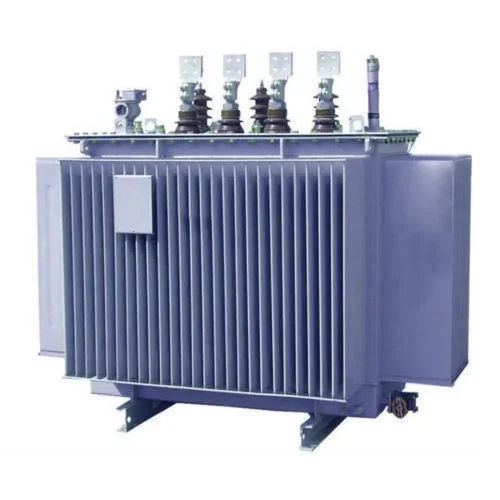
Electrical Power Transformer
Price 2500000.0 INR / Unit
Minimum Order Quantity : 10 Units
Usage : Industrial
Phase : Three Phase
Voltage Booster Type : Dry
Frequency (MHz) : 50 Hertz (HZ)
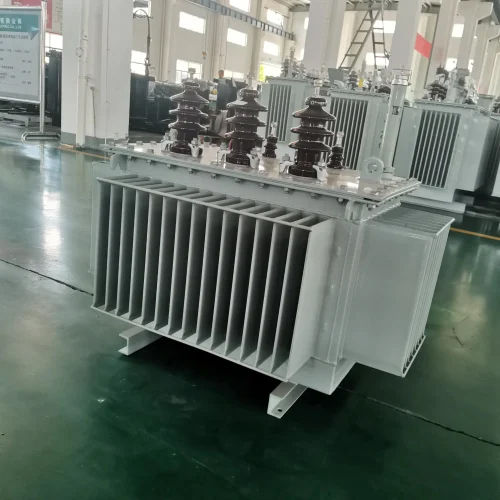
Three Phase Power Transformer
Price 2500000 INR / Unit
Minimum Order Quantity : 10 Units
Usage : Industrial
Phase : Three Phase
Voltage Booster Type : Dry
Frequency (MHz) : 50 Hertz (HZ)
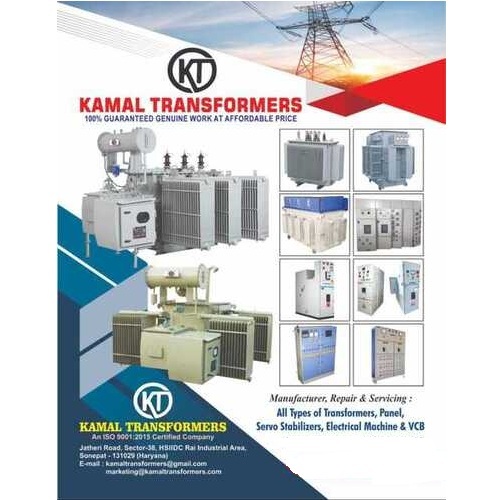
Electrical transformers
Price 250000 INR / Piece
Minimum Order Quantity : 1 Piece
Usage : Transformer
Phase : Three Phase
Voltage Booster Type : Dry
Frequency (MHz) : 50 Hertz (HZ)
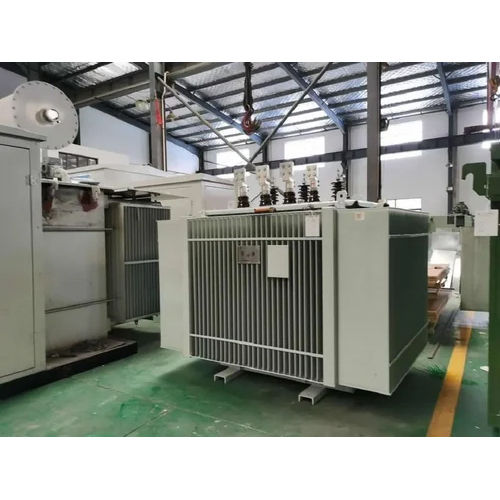
1000 kVA Power Transformer
Price 2000000 INR / Unit
Minimum Order Quantity : 10 Units
Usage : Industrial
Phase : Three Phase
Voltage Booster Type : Dry



Contact Details
GST : 06APCPK3923R2ZI
 Send Inquiry
 |
Kamal Transformers
All Rights Reserved.(Terms of Use) Developed and Managed by Infocom Network Private Limited. |
